
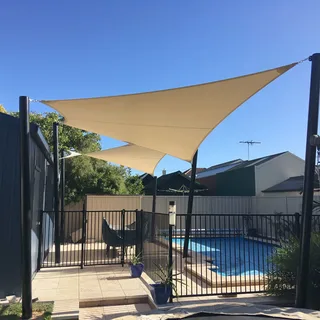
Introduction to Tensile Structures
Tensile fabric structures are lightweight architectural systems built from high-strength membranes stretched between rigid supports. Unlike conventional roofs, which rely on compression and bending stiffness (like steel beams or concrete slabs), tensile structures carry loads through tension only. In a perfect tensile design, every fiber pulls, and none compress.
How They Work
To resist external forces like wind, snow, and rain, the fabric must be pre-tensioned. This pre-stressing stabilizes the membrane. An un-tensioned fabric would flap in the wind and accumulate water, leading to pooling and structural failure. Engineers use specialized form-finding software to calculate the exact double-curvature geometries (e.g., conic, saddle, hypar shapes) required to ensure uniform load distribution.
Key Materials
- PVC-Coated Polyester: The workhorse of the industry. It is highly cost-effective, versatile, and has a lifespan of 15 to 20 years. PVDF topcoat lacquers are applied to make the fabric self-cleaning under rain.
- PTFE-Coated Fiberglass: The gold standard. PTFE is chemically inert, has an class-A fire rating, doesn't yellow with age, and has a lifespan exceeding 30 to 40 years. It is used on landmark installations like stadium canopies.
- ETFE Film: An ultra-lightweight fluorocarbon plastic sheet. Rather than a fabric, it is a transparent foil. It can be installed as single layers or inflated cushions, offering an alternative to heavy structural glass.
By using tensioned membranes, architects can cover vast spaces with minimal columns, lowering material costs and carbon footprints while creating iconic, fluid shapes.