
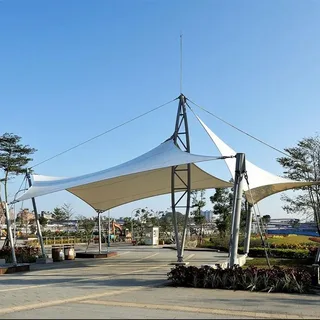
Choosing the Right Membrane
For most tensile structure projects, the selection comes down to PVC-coated polyester or PTFE-coated fiberglass. While both perform exceptionally well, their cost, lifecycle, and aesthetic profile differ significantly.
PVC-Coated Polyester
PVC (Polyvinyl Chloride) membranes are flexible, easy to weld using high-frequency machines, and cost-effective. They are coated with protective PVDF lacquers that resist dirt build-up. PVC is excellent for commercial walkways, car park shades, school playgrounds, and modular event pavilions. Lifespan ranges between 10 to 18 years.
PTFE-Coated Fiberglass
PTFE (Polytetrafluoroethylene) coated fiberglass is a highly durable compound. It is completely immune to UV degradation, has self-cleaning properties (dirt washes off completely with rainfall), and holds a Class-A fire classification. It is less flexible than PVC and requires expert care during handling. PTFE is ideal for permanent architectural structures, stadium roofs, and airports. It lasts 30 to 50 years.
Comparison Summary
| Feature | PVC Polyester | PTFE Fiberglass |
|---|---|---|
| Lifespan | 10-18 Years | 30-50+ Years |
| Fire Rating | Flame Retardant | Class-A Non-Combustible |
| Relative Cost | 1x (Standard) | 2x - 3x (Premium) |
| Self-Cleaning | Good (with PVDF) | Excellent (100% Inert) |